WEB DEVELOPMENT
Front-End vs. Back-End Development:
What’s the Difference?
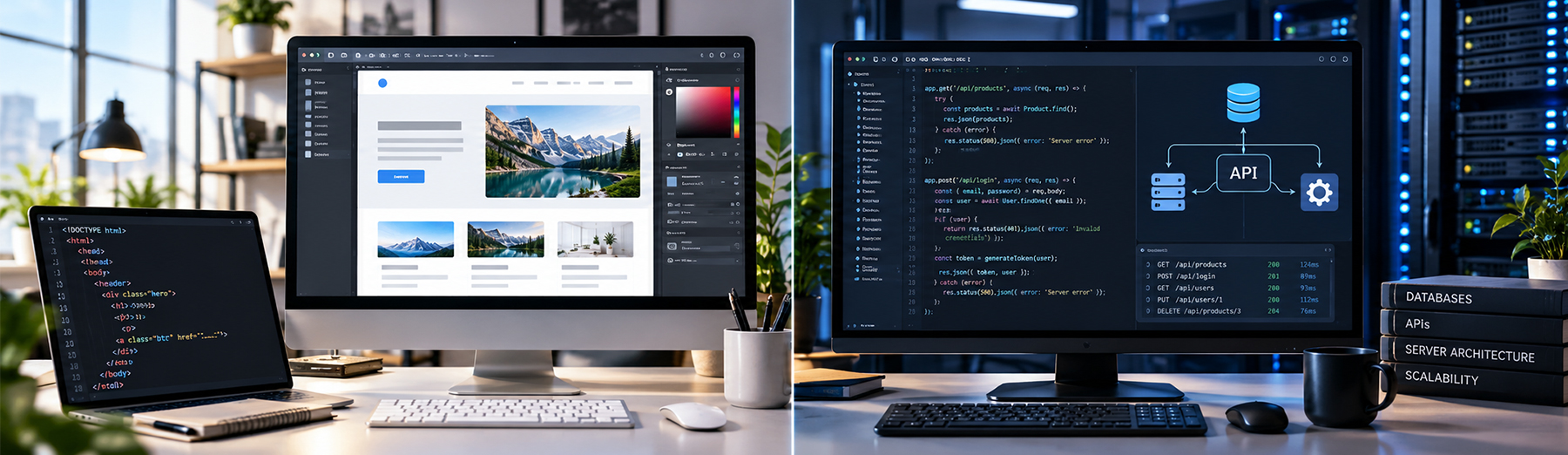
Front-end and back-end development are two essential parts of building a modern website or web application. Front-end development focuses on what users see and interact with, while back-end development handles the systems, data, logic, and functionality that operate behind the scenes.

What Is Front-End Development?
Front-end development focuses on the parts of a website or web application that users see and interact with directly in their browser.
It includes the visual layout, navigation, buttons, forms, animations, responsive behavior, and other interface elements that shape the user experience.
Front-end development commonly involves:
- HTML for page structure
- CSS for styling and layout
- JavaScript for interactivity
- Responsive design
- Navigation and menus
- Forms and input fields
- Buttons and calls to action
- Images, icons, and media
- Accessibility improvements
- Browser compatibility
- Performance optimization
- Integration with back-end data and functionality
The goal of front-end development is to create an interface that is clear, responsive, accessible, and easy for users to interact with across different devices.
Front-End Tip: Good front-end development combines design, usability, accessibility, and performance so the website not only looks right but also works smoothly.
What Is Back-End Development?
Back-end development focuses on the systems and functionality that operate behind the website interface. It handles data processing, business logic, user accounts, databases, integrations, and the communication between the website and server.
Back-end development commonly involves:
- Server-side programming
- Database management
- User authentication and permissions
- Form processing
- API integrations
- Ecommerce functionality
- Content management systems
- Data validation
- Security controls
- Server configuration
- Email and notification systems
- Communication with the front end
Users may not see the back end directly, but it is responsible for many of the actions that happen after they submit a form, log in, place an order, search a database, or interact with dynamic content.
Back-End Tip: Strong back-end development should make website functionality secure, reliable, scalable, and easy for the front end to use.
Front-End vs. Back-End Development: Key Differences
Front-end and back-end development work together, but they focus on different parts of the website.
| Factor | Front-End Development | Back-End Development |
|---|---|---|
| Primary Focus | User interface and browser experience | Server logic, data, and functionality |
| What Users See | Layouts, buttons, forms, navigation, and visible content | Usually operates behind the scenes |
| Common Technologies | HTML, CSS, and JavaScript | PHP, Python, Java, Node.js, and databases |
| Main Responsibilities | Design implementation, responsiveness, and interactions | Data processing, authentication, APIs, and integrations |
| Performance Focus | Page rendering, interaction speed, and responsive behavior | Server response, database efficiency, and processing |
| Security Role | Safe input handling and secure front-end behavior | Authentication, permissions, and data protection |
| Data Handling | Displays and sends data | Stores, processes, and returns data |
| Typical Output | Visible website interface | Functional systems that power the interface |
| Works With | Browsers and user devices | Servers, databases, APIs, and CMS platforms |
Neither side is more important than the other. A polished front end still depends on reliable back-end systems, while strong back-end functionality needs a usable interface for people to interact with it.
Development Tip: The best websites are built when front-end and back-end development are planned together instead of treated as completely separate systems.
How Front-End and Back-End Development Work Together
Front-end and back-end development are separate disciplines, but they depend on each other to create a complete website or web application.
The front end sends requests based on user actions, while the back end processes those requests, interacts with databases or services, and returns the information needed for the interface.
They commonly work together through:
- Forms and submissions
- User login systems
- Search functionality
- Ecommerce carts and checkout
- Account dashboards
- API connections
- Dynamic content
- Database-driven pages
- Email notifications
- Content management systems
- Customer portals
- Interactive tools
For example, when a visitor submits a contact form, the front end collects the information and sends it to the server. The back end validates the data, stores or processes it, and may trigger an email or CRM action before returning a confirmation to the user.
For a broader look at how these development stages fit into a complete project, see our guide on Website Development Process: From Planning to Launch.
Full-Stack Tip: Strong coordination between front-end and back-end development helps create websites that feel seamless to users while remaining reliable behind the scenes.
What Does a Front-End Developer Do?
A front-end developer builds and maintains the parts of a website or web application that users interact with directly.
Their work often includes:
- Turning design layouts into functional web pages
- Writing HTML, CSS, and JavaScript
- Building responsive layouts
- Creating navigation, buttons, and interactive elements
- Connecting forms and interfaces to back-end systems
- Improving accessibility
- Optimizing page speed and front-end performance
- Testing browser compatibility
- Fixing layout and interaction issues
- Maintaining reusable components and design systems
Front-end developers work closely with designers, back-end developers, content teams, and SEO specialists to make sure the website is visually accurate, usable, and technically sound.
Front-End Tip: A strong front-end developer combines visual accuracy with usability, accessibility, responsiveness, and performance.
What Does a Back-End Developer Do?
A back-end developer builds and maintains the systems that power website functionality behind the scenes.
Their work often includes:
- Writing server-side code
- Managing databases
- Building APIs and integrations
- Processing forms and user input
- Creating login and authentication systems
- Managing user roles and permissions
- Supporting ecommerce functionality
- Connecting websites to external services
- Handling data validation and storage
- Improving server-side performance
- Implementing security controls
- Troubleshooting application and database issues
Back-end developers work closely with front-end developers to make sure user actions are processed correctly and the website can deliver the right data and functionality when needed.
Back-End Tip: Strong back-end development should make website functionality secure, reliable, efficient, and scalable.
When a Website Needs Front-End or Back-End Development
The type of development a website needs depends on where the problem or requirement exists. Some issues are mostly visual and user-facing, while others involve data, logic, integrations, or server-side functionality.
Front-end development may be needed when:
- Page layouts need to be redesigned
- Mobile responsiveness is poor
- Navigation or buttons are difficult to use
- Forms need a better user experience
- Visual elements are inconsistent
- Accessibility issues affect the interface
- Page interactions feel slow or confusing
- New interactive components are required
Back-end development may be needed when:
- Forms need custom processing
- User accounts or permissions are required
- Data must be stored or retrieved
- APIs or third-party systems need to be connected
- Ecommerce functionality needs customization
- Business logic must be automated
- Database performance needs improvement
- Security or authentication requirements become more complex
Many website projects require both. A front-end improvement may also depend on back-end changes, especially when the user interface needs to display or process dynamic information.
Development Tip: Identify whether the issue is user-facing, system-related, or both before deciding what type of development work is required.
How Front-End and Back-End Development Affect Website Performance
Website performance depends on both the user-facing front end and the systems running behind the scenes. Slowdowns can come from either side, so improving speed often requires reviewing both.
Front-end performance can be affected by:
- Large images and media
- Excessive JavaScript
- Heavy CSS
- Too many animations or visual effects
- Render-blocking resources
- Poorly optimized fonts
- Inefficient responsive behavior
- Too many third-party scripts
Back-end performance can be affected by:
- Slow database queries
- Inefficient server-side code
- Heavy API requests
- Poor caching
- Overloaded hosting environments
- Unoptimized ecommerce processes
- Slow authentication or session handling
- Inefficient integrations
A fast front end cannot fully compensate for a slow server, and a fast server cannot prevent a poorly optimized interface from feeling sluggish.
Performance Tip: Website speed improves most when front-end and back-end performance are reviewed together rather than optimized in isolation.
How Front-End and Back-End Development Affect SEO
SEO can be influenced by both front-end and back-end development because search performance depends on how content is rendered, structured, delivered, and accessed.
Front-end factors that can affect SEO include:
- Heading structure
- Internal linking
- Mobile responsiveness
- Page speed
- Image optimization
- Accessible navigation
- JavaScript rendering
- Core Web Vitals
- Content visibility
- Semantic HTML
Back-end factors that can affect SEO include:
- Server response times
- Redirect handling
- Canonical URLs
- XML sitemap generation
- Robots and indexability settings
- Database performance
- Structured data output
- URL routing
- HTTP status codes
- CMS configuration
A technically strong SEO foundation requires coordination between both sides. Front-end improvements help search engines understand and render content, while back-end improvements help ensure that content is delivered correctly and efficiently.
SEO Tip: SEO works best when development decisions support crawlability, performance, rendering, and content structure across both the front end and back end.
How Tech Prime Web Approaches Front-End and Back-End Development
Tech Prime Web looks at front-end and back-end development as connected parts of the same website system. We evaluate how the user-facing experience, technical functionality, integrations, performance, and SEO work together rather than treating each area in isolation.
Key areas we consider include:
- Front-end usability and responsiveness
- HTML, CSS, and JavaScript implementation
- WordPress and CMS functionality
- Custom forms and integrations
- Server-side processing
- Database and API requirements
- Technical SEO
- Page speed and Core Web Vitals
- Maintainability
- Scalability for future growth
This helps determine whether a project needs front-end improvements, back-end development, or coordinated work across both areas.
Final Thoughts: Front-End vs. Back-End Development
Front-end and back-end development focus on different parts of a website, but both are essential to creating a complete digital experience.
Front-end development shapes what users see, how they navigate, and how they interact with the site. Back-end development supports the logic, data, integrations, and systems that make those interactions possible.
The strongest websites are built when both sides work together. Good front-end development improves usability, accessibility, and responsiveness, while strong back-end development supports reliability, performance, and functionality.
Final Takeaway: Front-end and back-end development serve different roles, but the best results come from treating them as connected parts of the same website system.