DIGITAL MARKETING
SEO, PPC and AI Search: How They Work Together
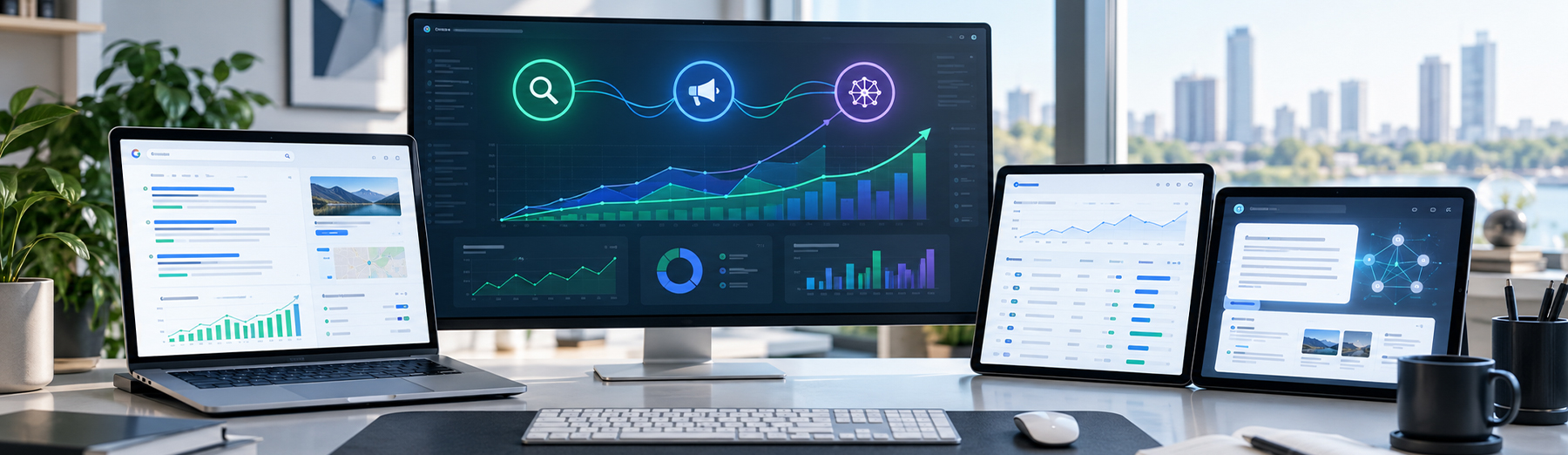
Search visibility is no longer limited to traditional organic rankings and paid ads. Businesses can now appear across Google organic results, paid search placements, AI Overviews, answer engines, and AI-driven discovery tools.
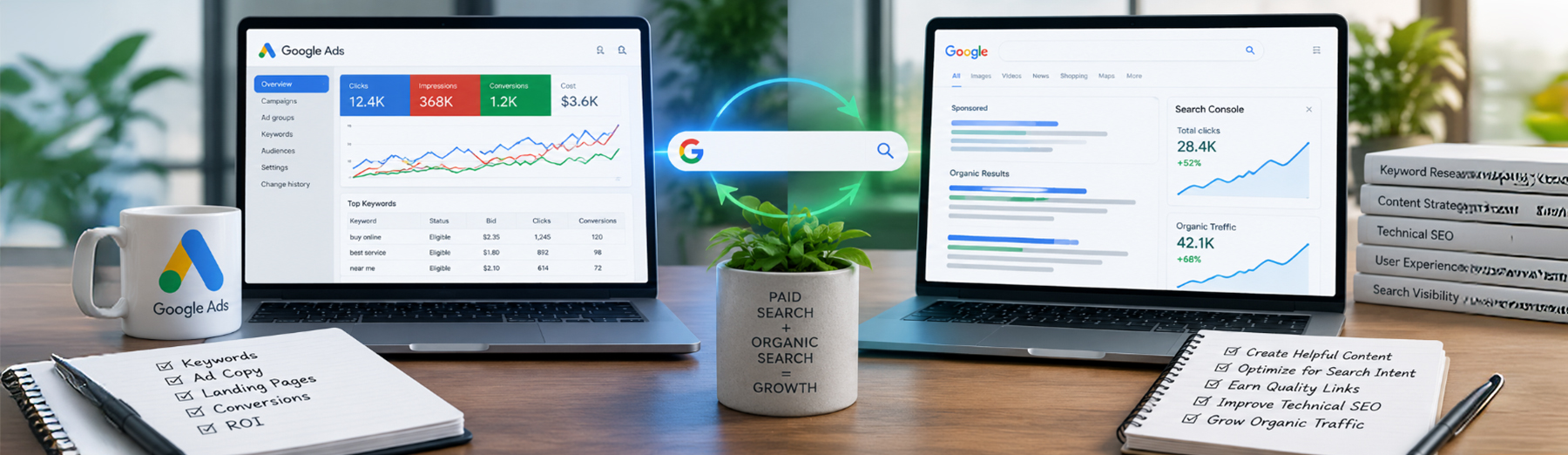
SEO, PPC, and AI search each play a different role. SEO builds long-term organic visibility, PPC creates faster paid exposure and testing opportunities, and AI search visibility depends heavily on clear, useful, authoritative content that answer engines can understand and reference.
For many businesses, the strongest strategy is not choosing one channel. It is aligning all three around the same search intent, messaging, landing pages, content, and conversion goals.
What Is the Difference Between SEO, PPC, and AI Search?
SEO, PPC, and AI search all help businesses gain visibility, but they do so in different ways.
- SEO focuses on earning organic visibility in search engines through useful content, technical optimization, site structure, authority, and relevance.
- PPC uses paid advertising to place businesses in sponsored search positions and can generate visibility more quickly.
- AI search focuses on appearing in answer-driven experiences such as AI Overviews and other AI assistants that summarize, synthesize, or cite information from multiple sources.
These channels can overlap, but they should not be treated as interchangeable.
SEO builds long-term organic visibility. PPC provides speed, targeting, and testing. AI search expands the opportunity to appear in newer discovery experiences where users may receive answers without clicking through a traditional results page.
Visibility Strategy Tip: Use each channel for what it does best, but keep the messaging, search intent, content, and conversion goals aligned across all three.
How SEO Supports AI Search Visibility
SEO provides much of the foundation that can also help content perform well in AI-driven search experiences. Clear site structure, technically accessible pages, useful content, strong internal linking, and authoritative information make it easier for search engines and AI systems to understand what a business offers.
SEO can support AI search visibility through:
- Clear answers to specific questions
- Strong topic coverage
- Helpful, original content
- Descriptive headings and page structure
- Internal linking between related topics
- Accurate business and service information
- Structured data where appropriate
- Fast, mobile-friendly pages
- Strong technical crawlability
- Consistent brand and entity signals
AI search optimization should not replace traditional SEO. In most cases, the same fundamentals that make content useful to search engines also make it easier for AI systems to interpret and surface.
For businesses that want to strengthen both organic visibility and answer-focused search presence, our SEO + AEO Services can help improve technical SEO, content structure, search intent alignment, and answer engine visibility.
AI Visibility Tip: Build content that answers real questions clearly and completely. AI-focused optimization works best when it strengthens useful content rather than adding separate “AI-only” pages or keyword stuffing.
How PPC Supports SEO and AI Search Strategy
PPC can provide fast search and conversion data that helps businesses understand which keywords, messages, offers, and landing pages are producing results.
Useful PPC insights can include:
- High-converting search terms
- Strong-performing ad messages
- Keyword demand
- Geographic performance
- Device performance
- Landing-page conversion rates
- Lead quality
- Audience behavior
- Cost per acquisition
- Seasonal search trends
Those insights can help guide SEO content priorities, landing-page improvements, and broader search strategy.
PPC can also support visibility while SEO and AI search efforts are still developing, especially for competitive or high-intent searches where organic visibility may take longer to build.
For businesses that want to improve paid search targeting, conversion tracking, and campaign performance, our Google & Microsoft Ads Management services can help connect PPC activity with broader search and lead-generation goals.
PPC Strategy Tip: Use paid search data as a testing engine. Search terms, conversion data, and landing-page performance can help reveal which topics and offers deserve more long-term SEO attention.
How SEO, PPC, and AI Search Can Work Together
SEO, PPC, and AI search are most effective when they support the same topics, services, and conversion goals instead of operating as separate marketing efforts.
A coordinated strategy can help businesses:
- Use PPC data to identify high-value search terms
- Build SEO content around proven search intent
- Strengthen service pages for both paid and organic traffic
- Create clearer answers for AI-driven search experiences
- Improve landing pages using conversion data
- Identify content gaps across the customer journey
- Maintain visibility while organic rankings are still developing
- Support branded and non-branded searches
- Align messaging across ads, service pages, and educational content
- Measure which channels contribute to leads and sales
For example, a business may use PPC to test a high-intent keyword, SEO to build long-term visibility around that topic, and answer-focused content to improve the chances of appearing in AI-generated results.
For businesses that want to improve visibility across AI-driven search experiences, our AI Visibility Optimization services can help strengthen content structure, entity signals, and answer-focused visibility.
Integrated Search Tip: Treat paid search, organic search, and AI visibility as parts of one search strategy. Shared data and consistent messaging can make each channel more useful.
How AI Search Is Changing the Customer Journey
AI-driven search experiences can change how people discover, compare, and evaluate businesses before they ever reach a traditional search result or website.
Instead of clicking through multiple pages, users may receive summarized answers that combine information from several sources. That makes clear, trustworthy, well-structured content increasingly important.
AI search can influence the customer journey by:
- Answering early research questions
- Comparing products, services, or approaches
- Summarizing business information
- Surfacing brands users may not already know
- Helping users evaluate options before visiting a website
- Shortening the path from research to decision
- Increasing the importance of clear expertise and entity signals
- Creating visibility beyond standard blue-link rankings
This means businesses should think about visibility across the entire decision process, not only whether a page ranks in a traditional search position.
AI Search Tip: Create content that helps users make decisions, not just content designed to attract clicks. Clear explanations, comparisons, examples, and direct answers are more useful across both traditional and AI-driven search.
Which Search Channel Should You Prioritize First?
The best starting point depends on the business goal, timeline, budget, current visibility, and how quickly results are needed.
Prioritize PPC first when you need:
- Immediate search visibility
- Fast keyword and offer testing
- Leads for a time-sensitive campaign
- Control over targeting and budget
- Data on which search terms convert
Prioritize SEO first when you need:
- Long-term organic visibility
- Broader keyword coverage
- Stronger service and content authority
- Reduced dependence on paid traffic over time
- A durable foundation for search growth
Prioritize AI search visibility alongside SEO when your audience frequently researches questions, comparisons, services, or solutions through AI-driven search experiences.
For many businesses, the strongest approach is not choosing only one. PPC can provide fast learning, SEO can build long-term visibility, and AI-focused optimization can expand how the brand appears across newer answer-driven search environments.
For a more detailed comparison of paid and organic search, see our guide on Google Ads vs. SEO: Which Is Better for Your Business?
Search Strategy Tip: Prioritize the channel that solves the most immediate business need, then use the other channels to strengthen visibility over time.
How to Measure SEO, PPC, and AI Search Performance
A coordinated search strategy should be measured by business outcomes, not just rankings, clicks, or impressions.
Useful metrics can include:
- Organic traffic
- Paid search traffic
- Qualified leads
- Cost per lead
- Conversion rate
- Customer acquisition cost
- Revenue
- Return on ad spend
- Landing-page performance
- Search term performance
- Branded search growth
- Visibility across priority topics
- Referral traffic from AI-driven platforms when identifiable
- Assisted conversions across multiple channels
SEO and PPC are generally easier to measure with established analytics and advertising data. AI search visibility can be harder to track directly, so businesses may need to look at referral traffic, branded search growth, assisted conversions, and changes in visibility across important topics.
The goal is to understand which channels are contributing to real business results and how they support each other throughout the customer journey.
Measurement Tip: Do not evaluate SEO, PPC, and AI search in isolation. Review how each channel contributes to leads, sales, and visibility across the full search journey.
How Content Strategy Supports SEO, PPC, and AI Search
Content is one of the main ways SEO, PPC, and AI search can reinforce each other. The same core topic can support organic rankings, paid campaigns, landing pages, and answer-driven visibility when the content is structured around clear user intent.
A stronger content strategy can include:
- Service pages for commercial searches
- Landing pages for paid campaigns
- Comparison content for decision-stage users
- Educational articles for broader search intent
- FAQs that answer specific questions
- Case studies that demonstrate expertise
- Internal links between related topics
- Updated content that reflects current services and terminology
- Clear headings that make answers easier to understand
- Original examples, insights, or experience that add value
For SEO, this helps build topical relevance and organic visibility. For PPC, strong content and landing pages can improve message alignment and conversion opportunities. For AI search, clear and useful answers can make the business easier to understand and reference.
Content Strategy Tip: Build content around real search intent and customer questions first. Then optimize that content so it can support organic search, paid campaigns, and AI-driven discovery at the same time.
How Landing Pages Connect SEO, PPC, and AI Search
Landing pages are where search visibility turns into business action. Whether a visitor arrives from an organic result, a paid ad, or an AI-driven recommendation, the page still needs to clearly explain the offer and guide the user toward the next step.
Strong landing pages should include:
- Clear alignment with search intent
- Relevant headlines and supporting content
- Strong calls to action
- Fast loading and mobile usability
- Trust signals
- Focused forms or conversion paths
- Consistent messaging with paid ads
- Useful supporting information for organic visitors
- Clear answers to common questions
- Analytics and conversion tracking
For PPC, landing-page relevance can directly affect campaign performance. For SEO, strong landing pages can support commercial search visibility. For AI search, clear page structure and direct answers can make the business easier to understand and reference.
Landing Page Tip: Do not create separate experiences for every channel unless there is a clear reason. Build strong core landing pages, then adapt messaging and calls to action where paid, organic, or AI-driven traffic has different intent.
How SEO, PPC, and AI Search Support Brand Visibility
SEO, PPC, and AI search can also work together to strengthen how often a business appears throughout the search journey.
A broader visibility strategy can help a brand appear through:
- Organic search results
- Paid search placements
- AI-generated answers
- Service and product pages
- Educational content
- Local search results
- Comparison searches
- Branded searches
- Retargeting and remarketing
- Search experiences across multiple devices
Repeated visibility can help reinforce brand recognition, especially when users encounter the same business across paid ads, organic listings, and AI-driven recommendations.
This does not mean appearing everywhere should be the goal. The focus should be on being visible in the places that matter most for relevant searches and business opportunities.
Brand Visibility Tip: Consistent messaging across SEO, PPC, and AI search can make the business easier to recognize, understand, and trust as users move through the decision process.
How Tech Prime Web Connects SEO, PPC, and AI Search
A stronger search strategy comes from connecting organic visibility, paid campaigns, AI-focused content, landing pages, analytics, and conversion goals instead of managing each channel separately.
Tech Prime Web can help with:
- SEO strategy and on-page optimization
- Technical SEO
- Google Ads and Microsoft Ads management
- Keyword and search intent research
- AI visibility optimization
- AEO-focused content structure
- Landing-page strategy
- Conversion tracking
- GA4 and analytics
- PPC and SEO performance reviews
- Content planning
- Ongoing visibility and lead-generation analysis
The goal is to use each channel where it provides the most value while keeping search intent, messaging, measurement, and conversion strategy aligned.
For businesses that want a more integrated approach, Tech Prime Web can connect SEO, PPC, analytics, landing pages, and AI visibility around the same growth goals.
Final Thoughts: SEO, PPC, and AI Search Work Best Together
SEO, PPC, and AI search each support visibility in different ways, but businesses can get more value when the channels are planned together.
SEO builds long-term organic visibility, PPC provides faster traffic and testing opportunities, and AI search expands how a business can appear in answer-driven discovery experiences.
The strongest strategy connects all three through shared search intent, consistent messaging, strong landing pages, useful content, analytics, and clear conversion goals.
Final Takeaway: Do not treat SEO, PPC, and AI search as isolated marketing channels. When they share data, content, and conversion goals, they can create a stronger and more resilient search visibility strategy.